Timely mortgage insights, strategies, and opportunities worth a closer look.

Featured Mortgage Articles
Clear explanations of mortgage topics that can affect your buying power, monthly payment, and financing decisions.
The terms pre-qualified and pre-approved are often used interchangeably, but they may represent different levels of mortgage preparation.
A pre-qualification is typically an early estimate of how much you may be able to borrow. It is based on information you provide about your income, debts, assets, and credit profile. It can be a useful starting point when establishing a price range, but the information may not yet have been fully documented or reviewed.
A pre-approval generally involves a more complete evaluation. You may be asked to provide income and asset documents, authorize a credit report, and complete a mortgage application. Depending on the lender and process used, your information may also be reviewed through an automated underwriting system.
A strong pre-approval helps you understand three important numbers: your estimated maximum loan amount, your expected monthly housing payment, and the funds you may need for the down payment and closing costs. It can also identify potential issues early, giving you time to address them before you find a home.
Neither a pre-qualification nor a pre-approval is a final loan approval. Final approval depends on updated borrower information, an acceptable property, appraisal, title review, underwriting, and satisfaction of the lender’s conditions.
The best time to begin is before you are ready to make an offer. That allows us to review the numbers, compare available loan options, and establish a comfortable buying range—not simply the maximum amount for which you may qualify.
Pre-Qualified vs. Pre-Approved: What is the Difference?
Mortgage Basics
Your debt-to-income ratio, commonly called DTI, compares your required monthly debt payments with your gross monthly income. It is one of the most important measurements lenders use when evaluating how much you may be able to borrow.
Monthly debts may include housing expenses, car loans, student loans, credit-card minimum payments, personal loans, child support, and other recurring obligations. Expenses such as groceries, utilities, insurance not included in the housing payment, and everyday living costs generally are not part of the formal DTI calculation.
DTI is important, but it does not determine buying power by itself. Your credit profile, down payment, available assets, loan program, interest rate, property taxes, homeowners insurance, and homeowners association dues can also affect the amount for which you may qualify.
Two buyers with the same income may therefore have very different buying power. A buyer with fewer monthly obligations may qualify for a larger housing payment, while another buyer may benefit from paying down certain debts before purchasing.
Calculating your DTI early gives you a useful starting point. It can help establish a realistic price range, identify debts that may be limiting your options, and show how changes to the loan structure could affect your monthly payment.
The objective is not simply to determine the maximum amount a lender may approve. It is to understand the numbers and choose a mortgage payment that supports your broader financial goals.
Understanding Your Debt-to-Income Ratio
Buying Power
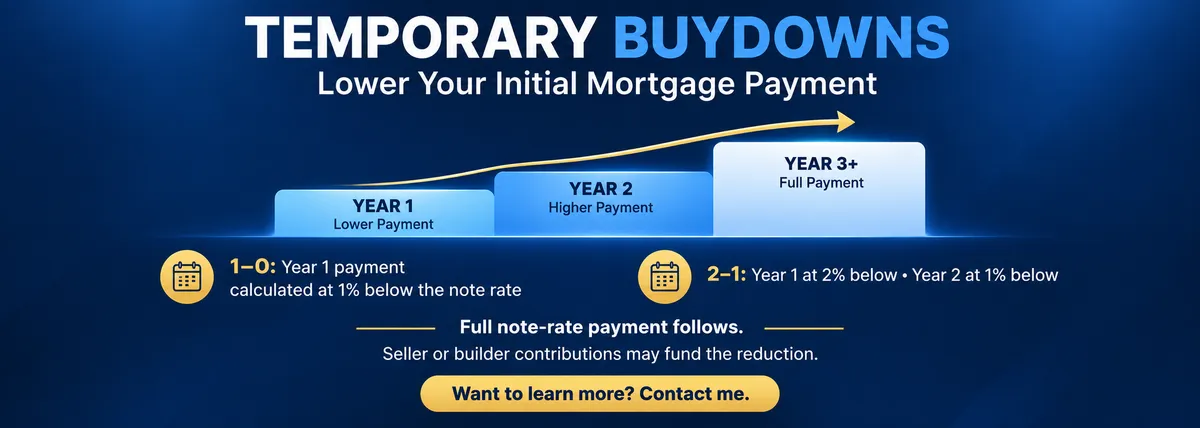
A temporary buydown reduces a borrower’s mortgage payments during the first one or two years of the loan. It can provide payment relief during the early years of homeownership while the borrower adjusts to the expenses of owning a home.
With a 1-0 buydown, the first-year payment is calculated as though the interest rate were one percentage point below the loan’s note rate. The full payment begins in the second year.
With a 2-1 buydown, the first-year payment is calculated at two percentage points below the note rate. The second-year payment is based on one percentage point below the note rate, and the full payment begins in the third year.
The mortgage’s actual note rate does not change. Funds deposited at closing subsidize the difference between the reduced initial payments and the full scheduled payments. These funds are commonly provided through a seller or builder contribution, subject to loan-program requirements and contribution limits.
Borrowers generally must qualify using the full note-rate payment, not the temporarily reduced payment. It is therefore important to understand what the payment will become after the buydown period ends.
A temporary buydown can be especially useful when a seller is willing to contribute toward the buyer’s financing costs. Whether it provides greater value than a price reduction or another use of seller funds depends on the purchase price, loan terms, available contribution, and the buyer’s financial priorities.
Why Your Credit Score Matters
Credit & Qualification
A temporary buydown reduces a borrower’s mortgage payments during the first one or two years of the loan. It can provide payment relief during the early years of homeownership while the borrower adjusts to the expenses of owning a home.
With a 1-0 buydown, the first-year payment is calculated as though the interest rate were one percentage point below the loan’s note rate. The full payment begins in the second year.
With a 2-1 buydown, the first-year payment is calculated at two percentage points below the note rate. The second-year payment is based on one percentage point below the note rate, and the full payment begins in the third year.
The mortgage’s actual note rate does not change. Funds deposited at closing subsidize the difference between the reduced initial payments and the full scheduled payments. These funds are commonly provided through a seller or builder contribution, subject to loan-program requirements and contribution limits.
Borrowers generally must qualify using the full note-rate payment, not the temporarily reduced payment. It is therefore important to understand what the payment will become after the buydown period ends.
A temporary buydown can be especially useful when a seller is willing to contribute toward the buyer’s financing costs. Whether it provides greater value than a price reduction or another use of seller funds depends on the purchase price, loan terms, available contribution, and the buyer’s financial priorities.
How Temporary Buydowns Work
Payment Strategies
A temporary buydown reduces a borrower’s mortgage payments during the first one or two years of the loan. It can provide payment relief during the early years of homeownership while the borrower adjusts to the expenses of owning a home.
With a 1-0 buydown, the first-year payment is calculated as though the interest rate were one percentage point below the loan’s note rate. The full payment begins in the second year.
With a 2-1 buydown, the first-year payment is calculated at two percentage points below the note rate. The second-year payment is based on one percentage point below the note rate, and the full payment begins in the third year.
The mortgage’s actual note rate does not change. Funds deposited at closing subsidize the difference between the reduced initial payments and the full scheduled payments. These funds are commonly provided through a seller or builder contribution, subject to loan-program requirements and contribution limits.
Borrowers generally must qualify using the full note-rate payment, not the temporarily reduced payment. It is therefore important to understand what the payment will become after the buydown period ends.
A temporary buydown can be especially useful when a seller is willing to contribute toward the buyer’s financing costs. Whether it provides greater value than a price reduction or another use of seller funds depends on the purchase price, loan terms, available contribution, and the buyer’s financial priorities.
How DSCR Loans Work for Investors
Investor Financing
A temporary buydown reduces a borrower’s mortgage payments during the first one or two years of the loan. It can provide payment relief during the early years of homeownership while the borrower adjusts to the expenses of owning a home.
With a 1-0 buydown, the first-year payment is calculated as though the interest rate were one percentage point below the loan’s note rate. The full payment begins in the second year.
With a 2-1 buydown, the first-year payment is calculated at two percentage points below the note rate. The second-year payment is based on one percentage point below the note rate, and the full payment begins in the third year.
The mortgage’s actual note rate does not change. Funds deposited at closing subsidize the difference between the reduced initial payments and the full scheduled payments. These funds are commonly provided through a seller or builder contribution, subject to loan-program requirements and contribution limits.
Borrowers generally must qualify using the full note-rate payment, not the temporarily reduced payment. It is therefore important to understand what the payment will become after the buydown period ends.
A temporary buydown can be especially useful when a seller is willing to contribute toward the buyer’s financing costs. Whether it provides greater value than a price reduction or another use of seller funds depends on the purchase price, loan terms, available contribution, and the buyer’s financial priorities.
The Fed Raised Rates- What Does It Mean for Mortgages
Market & Rates
Explore the Resource Library
Browse additional mortgage articles, videos, guides, and practical insights for homebuyers, homeowners, and real-estate investors.
Learn how DSCR loans help Houston real estate investors qualify based on a property’s rental income, plus key considerations for financing and cash flow. ...more
Gaston Garrido | NMLS #2146920 | Barrett Financial Group, L.L.C. | NMLS #181106 | 2701 East Insight Way, Suite 150, Chandler, AZ 85286 | TX view complaint policy at barrettfinancial.com/texas-complaint | Equal Housing Opportunity | This is not a commitment to lend. All loans are subject to credit approval. | nmlsconsumeraccess.org/EntityDetails.aspx/COMPANY/181106